The Freelance Skills That Pay $100+ Per Hour in 2026 (And the AI Tools Nobody's Talking About)
Feb 17, 2026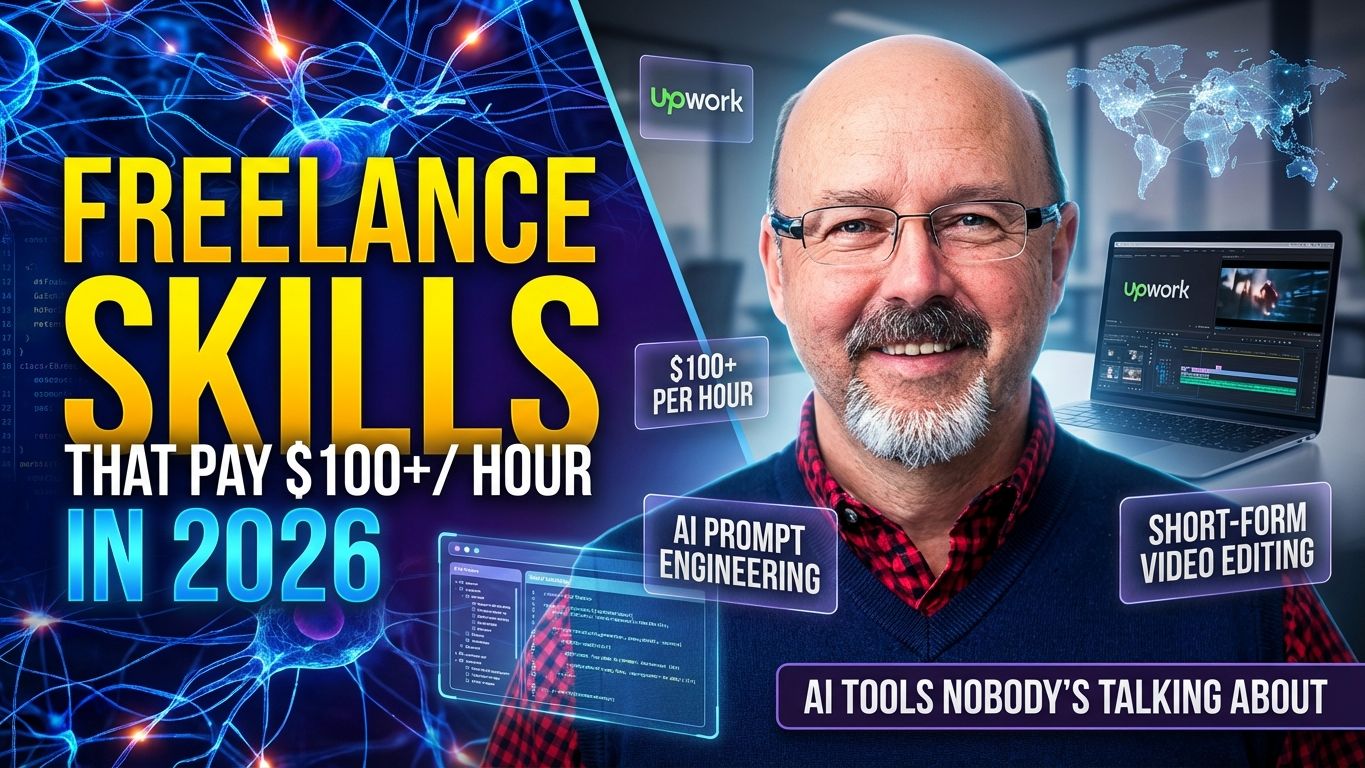
TL;DR: The freelance market in 2026 pays $100+ per hour for skills at the intersection of human creativity and AI execution. AI prompt engineering averages $146K annually, while short-form video editing offers $40-$120 per project with consistent demand. Platforms like Upwork show 40% growth in remote work postings. The barrier to entry is lower than ever. You don't need years of training. You need proof you can execute. Start with one skill, complete 5-10 projects, build proof, raise rates, repeat.
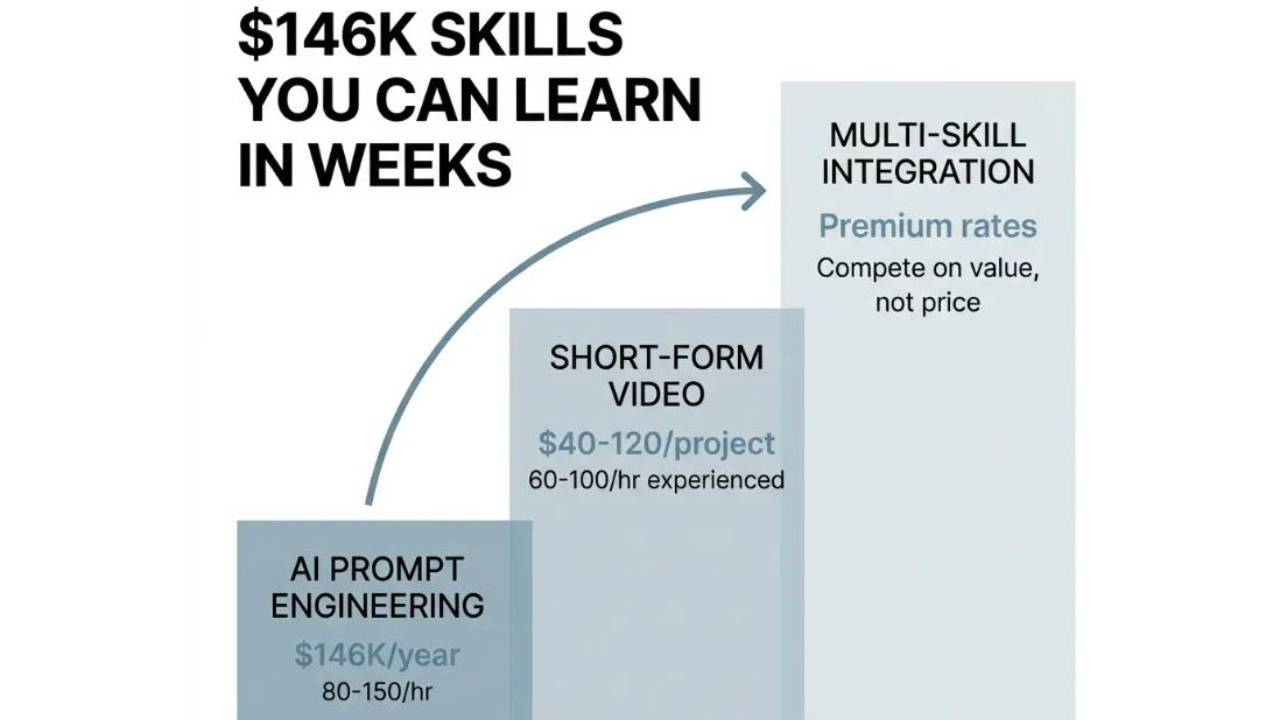
Two skills dominate high-paying freelance work in 2026:
-
AI prompt engineering pays $80-$150/hour because you translate business problems into AI instructions (no computer science degree required)
-
Short-form video editing earns $40-$120 per project with 2-3 hour turnaround times
-
Upwork reported 40% year-over-year growth in remote work postings and 27% increase in AI-related skill demand
-
Beginners earn within weeks by completing small projects. Rate increases happen after 10-20 consistent deliveries
-
Automation tools like Make and Zapier multiply your output. What took 3 hours now takes 15 minutes
I've been watching the freelance market for two decades.
Something shifted in the past six months.
The skills paying well in 2024 are getting commoditized. The ones exploding right now? They're where human creativity meets AI execution. Freelance job postings increased by 22% in the FlexJobs database over the past six months alone.
Here's what I'm seeing work.
What's Happening in the Freelance Market Right Now?
More than 72 million U.S. professionals work independently right now.
That number hits 86 million by 2027.
Remote work reached 52% of the global workforce in 2026. Almost double the pre-pandemic level.
The opportunity window is open.
It closes fast when everyone figures out the same playbook.
I spent the last three months testing which skills convert to paid projects within weeks. The results surprised me.
Bottom line: The freelance market is expanding rapidly, creating immediate earning opportunities for people who move now. The window stays open for those willing to execute before feeling fully prepared.
How Does AI Prompt Engineering Pay $146K Without a Tech Degree?
The average annual pay for AI Prompt Engineering in the United States is $146,868 a year.
Freelancers with this skill earn $80-$150 per hour on Upwork and Toptal.
You don't need a computer science degree.
Prompt engineers rely on communication and critical thinking skills more than technical backgrounds.
You're translating business problems into AI instructions. Then refining the output until it's usable.
I tested this last month.
Client had a vague request for "better marketing copy." I turned it into a structured prompt system. The AI generated 15 variations. Client picked three.
Total time: 90 minutes. Payment: $225.
The skill compounds.
Each project teaches you what works. Your prompt library grows. Your speed increases. Your rates follow.
The shift: You stop feeling like you need years of training before charging premium rates. You see the value is in your ability to think clearly and communicate precisely.
Key insight: AI prompt engineering rewards clear thinking and precise communication over technical credentials. The skill compounds with each project, allowing faster work and higher rates over time.
Why Is Short-Form Video Editing in High Demand?
Short-form video editing for TikTok, Instagram Reels, or YouTube Shorts offers $40-$120 per project.
Social media budgets are driving demand.
Typical project ranges in 2026:
Short projects (social clips, quick promos) run $100-$500. Medium projects (corporate videos, YouTube content, explainer videos) hit $500-$2,500.
The entry barrier is low.
Upwork's rates typically fall between $10 and $60 per hour. Beginners start at $20-$40 per hour. Experienced editors charge $60-$100+ per hour.
I watched a friend go from zero to $3,000 monthly income in eight weeks.
She edited short clips for local businesses. Added captions, transitions, and music. Each project took 2-3 hours.
The pattern: Start small. Build a portfolio of 10-15 clips. Show results. Raise rates.
The freedom: You work from anywhere. Your laptop and an internet connection are your entire business infrastructure. The stress of commuting and office politics disappears.
Key insight: Short-form video editing offers quick project turnaround and consistent demand. Beginners build portfolios fast and scale to $3,000+ monthly income within weeks.
Which Platforms Offer the Best Freelance Opportunities?
Upwork data shows a 40% year-over-year rise in postings for remote work jobs.
Real market demand.
Upwork reported a 27% increase in demand for freelancers with AI-related skills.
Fiverr saw content strategy, UX design, and automation rise among the top five fastest-growing service categories.
Both platforms provide payment protection.
Upwork has paid over $15 billion to freelancers since its inception. Fiverr has had over 50 million transactions. Both hold payment until work is completed.
This removes the "getting paid" friction that stops many people from executing.
I've used both platforms for years.
The protection works. You deliver the work. The money shows up. No chasing invoices. No awkward payment conversations.
The confidence: You stop worrying about whether clients will pay you. The platform handles it. You focus on delivering quality work.
Key insight: Upwork and Fiverr provide payment protection and show 27-40% growth in demand. Both platforms have processed billions in payments, removing the risk of non-payment.
How Fast Can Beginners Start Earning?
Beginners earn within weeks by completing small projects or entry-level gigs.
Practice builds a portfolio. Higher-paying clients follow.
Consistent delivery of 10-20 projects typically allows rate increases.
The barrier to entry has never been lower.
To get your first video editing job, start small. Edit short projects for friends, local businesses, or content creators. Use those clips in your portfolio. Focus your proposals on results, not years of experience.
I tested this theory with a client who had zero portfolio.
We created three sample videos using free stock footage. Showed what he could do. He landed his first paid project within a week.
The pattern repeats across skills.
You don't need permission. You need proof you can execute.
The relief: You stop waiting for the "right time" to start. You see imperfect action today beats perfect planning tomorrow.
Key insight: Beginners earn within weeks by starting small. After 10-20 projects, rate increases become standard. Proof of execution matters more than years of experience.
Why Do Multi-Skill Freelancers Earn More?
Both platforms noted growing demand for multi-disciplinary freelancers.
Those who combine creativity, tech, and communication.
Clients don't hire for output anymore. They want freelancers who think strategically, use AI intelligently, and deliver measurable results.
The line between "creative" and "technical" has blurred.
The best freelancers are adaptable problem-solvers who navigate multiple layers of a project.
I've seen this in my own work.
Clients hire me for automation. They stay because I understand their marketing goals. I write copy. I structure workflows. I explain technical concepts in plain language.
The integration creates value single-skill freelancers don't match.
The power: You stop competing on price. You compete on the unique combination of skills only you bring to the table.
Key insight: Multi-disciplinary freelancers command higher rates because they solve problems across creative, technical, and strategic domains. Skill integration creates unique value.
Which AI Tools Multiply Your Freelance Output?
ChatGPT gets all the attention.
The real productivity gains come from tools that automate repetitive tasks.
I've been using automation tools for 8-10 years. The landscape changed dramatically in 2025-2026.
Make (formerly Integromat) offers a visual programming environment.
You see your entire workflow. Connect apps. Move data. Trigger actions based on conditions.
I use it to scrape content, format it, and distribute it across platforms.
What used to take 3 hours now takes 15 minutes.
The benefit: You stop feeling overwhelmed by repetitive tasks. You set up the automation once. It runs forever. You focus on high-value work.
Zapier remains solid for simple automations. I've used it for years.
The lifetime edition I didn't buy still haunts me. The monthly subscription works fine.
Key insight: Automation tools like Make and Zapier multiply your output by 10-12x. They don't replace your skills. They free you to focus on high-value work while repetitive tasks run automatically.
How Do You Start Today?
I value implementation over learning.
You read about freelancing for months. Or you complete your first project this week.
The market rewards action.
Your first project teaches you more than ten courses.
Start with one skill. Pick the one matching your existing strengths.
If you write well, try prompt engineering. If you understand visual storytelling, try video editing.
Complete 5-10 small projects. Build proof. Raise your rates. Repeat.
The pattern works because it's based on demonstrated capability. Not theoretical knowledge.
The transformation: You stop identifying as someone who "wants to freelance someday." You become someone who freelances. The identity shift changes everything.
Key insight: Implementation beats learning. Start with one skill matching your strengths, complete 5-10 projects, build proof, raise rates. Action generates results faster than courses.
What Happens Next?
The freelance market in 2026 rewards speed and adaptability.
The skills paying well today might be commoditized tomorrow.
The pattern remains constant: Find where demand exceeds supply. Build proof you can deliver. Execute consistently. Raise rates as your portfolio grows.
The tools exist. The platforms exist. The demand exists.
The only variable is your willingness to start before feeling ready.
I've watched hundreds of people make this transition.
The ones who succeed share one trait: They ship imperfect work faster than people who wait for perfect conditions.
Your move.
What skill are you testing first? The market is moving. The opportunity window stays open for people who execute now.
Frequently Asked Questions
Do I need a degree or certification to start freelancing in 2026?
No. AI prompt engineering and video editing reward demonstrated capability over credentials. Clients hire based on your portfolio and results, not degrees. Build proof through 5-10 small projects.
How long before I earn my first freelance income?
Beginners earn within weeks. Create 3-5 sample projects, list them on Upwork or Fiverr, and apply for entry-level gigs. Payment protection ensures you get paid when you deliver.
Which skill pays more: AI prompt engineering or video editing?
AI prompt engineering averages $146K annually ($80-$150/hour). Video editing offers $40-$120 per project with 2-3 hour turnaround. Both provide strong income. Pick the one matching your existing strengths.
Are Upwork and Fiverr safe for payment?
Yes. Upwork has paid over $15 billion to freelancers. Fiverr processed over 50 million transactions. Both hold payment until work is completed, removing non-payment risk.
What tools do I need to automate my freelance work?
Make and Zapier multiply your output by 10-12x. Make offers visual workflow building. Zapier handles simple automations. Both free you from repetitive tasks, letting you focus on high-value work.
How do I raise my freelance rates?
Consistent delivery of 10-20 projects typically allows rate increases. Build social proof through reviews. Show measurable results. Transition from hourly to project-based pricing as your portfolio grows.
Should I focus on one skill or learn multiple skills?
Start with one skill matching your strengths. Build proof. Earn consistently. Then add complementary skills. Multi-disciplinary freelancers command higher rates, but mastery of one skill comes first.
What if I don't have any portfolio pieces yet?
Create 3-5 sample projects using free resources. Video editors use stock footage. Prompt engineers document AI workflows. Show what you can do. Proof of execution beats years of theoretical experience.
Key Takeaways
-
AI prompt engineering pays $80-$150/hour without requiring a tech degree. The skill rewards clear thinking and communication, compounding with each project.
-
Short-form video editing offers $40-$120 per project with 2-3 hour turnaround times. Beginners scale to $3,000+ monthly income within weeks.
-
Upwork shows 40% year-over-year growth in remote work postings. Fiverr reports 27% increase in AI-related skill demand. Both platforms provide payment protection.
-
Beginners earn within weeks by starting small. After 10-20 consistent projects, rate increases become standard. Proof of execution beats credentials.
-
Multi-disciplinary freelancers command higher rates by solving problems across creative, technical, and strategic domains. Start with one skill, then add complementary capabilities.
-
Automation tools like Make and Zapier multiply output by 10-12x. Tasks taking 3 hours now take 15 minutes, freeing you for high-value work.
-
Implementation beats learning. Start with one skill, complete 5-10 projects, build proof, raise rates, repeat. Action generates results faster than courses.
Stay connected with news and updates!
Join our mailing list to receive the latest news and updates from our team.
Don't worry, your information will not be shared.
We hate SPAM. We will never sell your information, for any reason.